
Washington County Court Records After a Jail Arrest
After an arrest in Washington County, a person is booked into the county jail and a custody record opens. The court record is separate. It starts when the State Attorney for Florida's 14th Judicial Circuit reviews the law-enforcement report and files a charging document. From that point the court record tracks the charges, the hearings, the rulings, and the outcome. The Clerk of Court in Chipley keeps that file, and the public can search it once a case is open and not confidential.
It helps to keep the two sides apart. The booking and custody detail lives on the jail inmate records page, and the booking photo lives on the jail roster mugshots page. The court record covered here is the set of charges the prosecutor filed and what the court did with them after the arrest. The words may overlap, but the offices and the files do not.
How to Find Washington County Court Records After an Arrest
Court charges and case status show up in the Clerk's Online Court Records Search, known as OCRS, run through the state Civitek system. Public access is anonymous and free, while attorney, registered, and party access require a login. The lead-in image below shows the access screen. Reviewing the Washington County OCRS access page shows the Public, Attorney, Registered User, and Party Access choices.
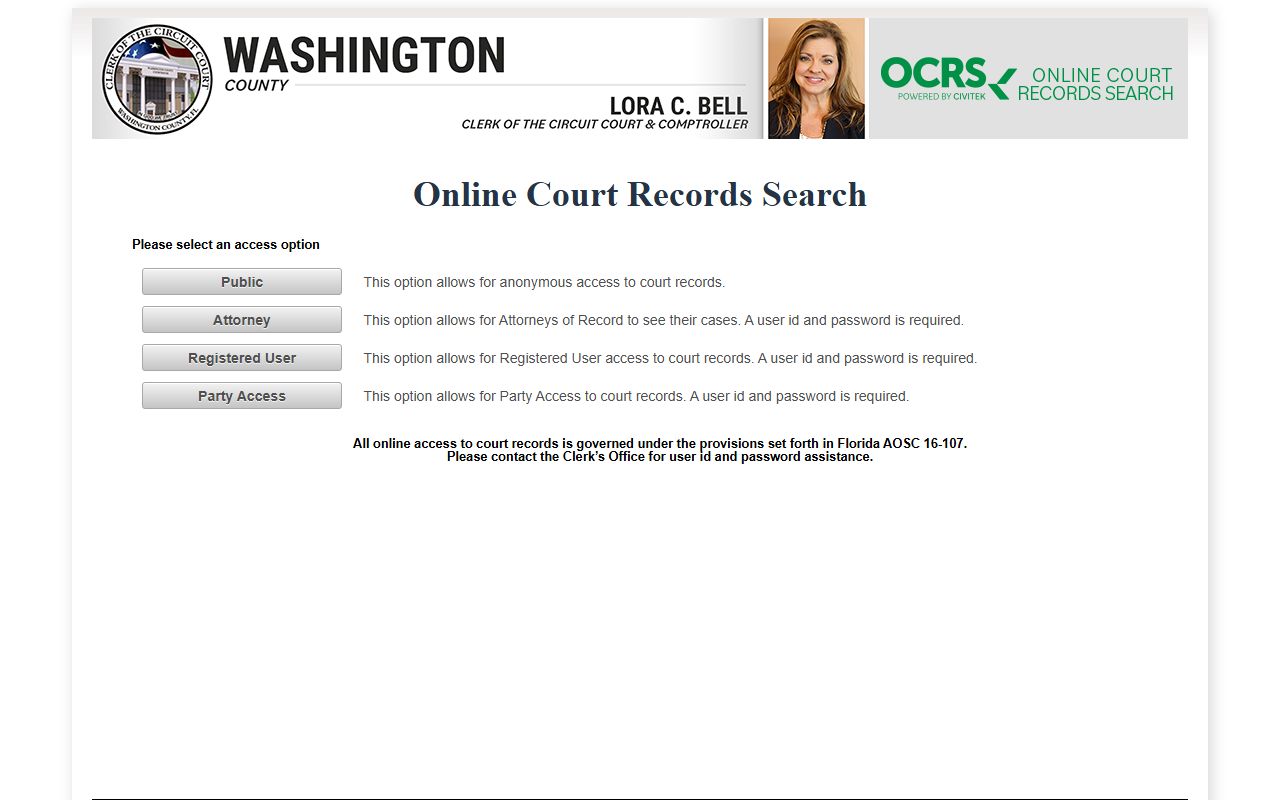
The booking and arrest detail stays on the jail roster. The court record is what you build through these steps.
- Open OCRS for Washington County and choose Public access.
- Search by the defendant's last name, or by a case number if you have one.
- Open the case and read the charge list and the docket of court events.
- Check each charge's code, level, and current status.
The Clerk's records search page links both court records and the official records index, and the Washington County Clerk records search is the hub for both. OCRS results can include the case number, the charge description, the parties, the attorneys, the docket of events, sentences, and a financial summary. Some images are normal images while others are marked View on Request and need Clerk review first. For a deeper criminal-history check across the state, Florida's public-records statutes govern what is open, covered further down this page.
OCRS Person Search Fields
The OCRS person search accepts a name plus several optional filters. A last name is the usual starting point, and the court-type boxes let you limit the search to felony or misdemeanor filings. The table below lists the documented fields.
| Field Label | Type | Required | Notes |
|---|---|---|---|
| Last Name | Text | Yes, unless a business name is used | Max length 30. |
| First Name/MI | Text | No | Max length 40. |
| Date Case Filed (From / To) | Date | No | MM/DD/YYYY range. |
| Date of Birth | Date | No | MM/DD/YYYY. |
| Court Type | Checkbox group | No | CF felony, MM misdemeanor, CT criminal traffic, and more. |
Note: the SSN field is masked and is best left blank unless a search truly needs it, since court records are public and broadly visible.
How Charges Get Filed After an Arrest
The court record opens with a charging document. After the arrest and booking, the State Attorney reviews the evidence and decides whether charges can be filed. In Florida most felonies are charged by an information filed by the prosecutor, while a grand jury returns an indictment for the most serious cases. If charges are not filed, a No Information notice closes the matter and the person is released if still held. The table below compares the three documents that can start a case.
| Complaint | Information | Indictment | |
|---|---|---|---|
| Filed By | Officer or prosecutor | State Attorney | Grand jury |
| Common For | Initial accusation | Many felonies | Serious felonies |
| Starts | The case | The case | The case |
The arraignment is the hearing where the accused is brought before the court to plead to that charging document. The Clerk's felony guidance describes it as the proceeding to answer an information, indictment, or citation.
Charge Status and What It Means
Charges change as a case moves. They can be amended, reduced, added, dropped, or dismissed, and the charges shown at booking can differ from the charges the prosecutor finally files. That gap matters, because a roster charge is what the arresting officer wrote, while a court charge is what the prosecutor decided to pursue. Reading the status of each charge is the key to understanding a court record. The common terms are defined below.
- Pending
- The charge is filed and the case is still moving through the court.
- Amended or reduced
- The prosecutor changed the charge, often to a lesser offense.
- Dismissed
- The court ended the charge without a conviction.
- Nolle prosequi
- The prosecutor chose to drop the charge before a verdict.
- No Information
- The State Attorney declined to file at all, and the person is released if still held.
Roster charges are not final charges: the offense listed on the jail roster comes from the arrest, while the charge in the court record is what the prosecutor actually filed. The two can differ in count, level, or wording, so always read the court record for the filed charge.
Who Files Charges in Washington County
Washington County is part of Florida's 14th Judicial Circuit, and the State Attorney handles charging here. The Washington County office sits in the courthouse complex in Chipley, and the lead-in image below shows the office's page. Reviewing the 14th Circuit State Attorney Washington County page shows the local office contact and the case-process overview.
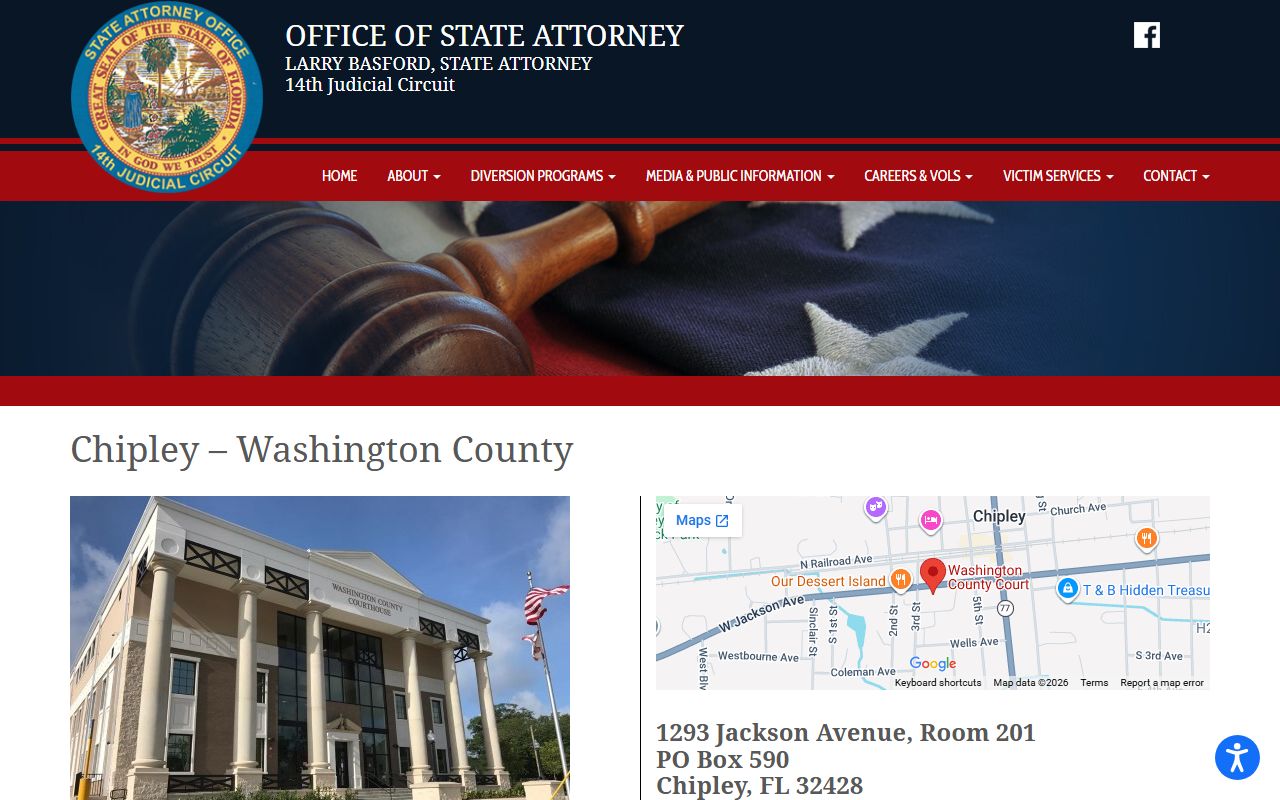
The arrest decision belongs to law enforcement where the crime happened. The charging decision belongs to an Assistant State Attorney, who reviews the report after the arrest and decides whether the evidence supports a filed charge. The Washington County office sits at 1293 Jackson Avenue, Room 201, in Chipley, and the same complex area holds the Clerk of Court, so a single courthouse trip can cover both the case file and the charging side.
The State Attorney also keeps its own public records. Those requests go through a public-records coordinator in Panama City, who accepts them by phone, mail, or email, and Florida law does not require a requester to give a name or a reason. Copy fees start at a few cents per page, with no charge for ten pages or fewer, and special service charges apply when a request takes extensive staff time.
Bond and Release After an Arrest
Bond is the money or condition that lets a person leave custody while the case is open. In Florida only a judge may set, reduce, or change bail except where a statute allows otherwise, and bail is meant to ensure the person appears and to protect the community. A bond amount does not always mean release, since a hold or a detainer can keep someone in custody anyway. The main release routes are these:
- Cash bond - the full amount is paid directly to secure release.
- Surety bond - a licensed bail agent posts the bond for a fee.
- Release on recognizance - release on a written promise to appear, without upfront money.
- No-bond hold - no release is available until a court acts or a hold clears.
Florida law also frames bond factors such as the offense, ties to the community, finances, and any history of failing to appear. The Clerk's felony guidance links a weekly pretrial release report tied to the state's Citizens' Right-to-Know framework.
Warrants That Lead to an Arrest
Many arrests start with a warrant. A missed court date can bring a bench warrant, and an unpaid fine or a probation problem can bring a capias, which is a court order to arrest. The Clerk's guidance says a person with a bench warrant must turn themselves in at the Washington County Jail, or at the nearest law-enforcement agency if they are outside the county, then post any bond the judge requires and receive a new court date about three weeks out. The sheriff's wanted page lists some outstanding warrant subjects, and a records request covers anything not online.
Charges vs. Convictions
Being arrested and charged is not the same as being convicted. A charge is an accusation that opens the court record. A conviction is the outcome after a plea or a verdict. Both are public, but they mean very different things.
| Charge | Conviction | |
|---|---|---|
| Stage | Accusation | Verdict or plea |
| Burden of Proof | Probable cause | Beyond a reasonable doubt |
| Public Record | Yes | Yes |
Sealed vs. Expunged Records
After a dismissal or an eligible outcome, a person may be able to clear a record. Florida law separates sealing from expunction, and the State Attorney's seal and expunge guidance points applicants to the Florida Department of Law Enforcement for the certificate of eligibility. The table below compares the two.
| Sealed | Expunged | |
|---|---|---|
| Visibility | Hidden from public view | Destroyed or treated as never existing |
| Law Enforcement | Limited access remains | Very limited access |
| Florida Statute | § 943.059 | § 943.0585 |
Both routes run through a court order, and the relevant statutes are Florida Statutes 943.059 for sealing and 943.0585 for expunction.
Restricted Court Records After an Arrest in Washington County
Not every court record after an arrest is open online. Juvenile matters, sealed charges, and some dismissed cases are restricted, and certain documents in OCRS are marked View on Request, meaning the Clerk reviews them for redaction before release. Florida's court-records statute makes case files generally public while allowing exemptions and limits on online access. When a record is restricted, the path is a request to the Clerk rather than a public OCRS view, and the Clerk's felony information page explains the local handling.