
Northwest Florida Reception Center Annex Overview
The Annex operates under the Florida Department of Corrections at 4455 Sam Mitchell Drive in Chipley, the same address as its parent, the Northwest Florida Reception Center. Its population is adult male, and its listed warden is Chadd Harrell, shared with the parent institution. The FDOC treats the Annex as a distinct facility even though the two share a campus, a main phone, and an email. The lead-in image below shows the Annex's official page. Reviewing the FDOC Northwest Florida Reception Center Annex page shows the facility's contacts, capacity, and programs.
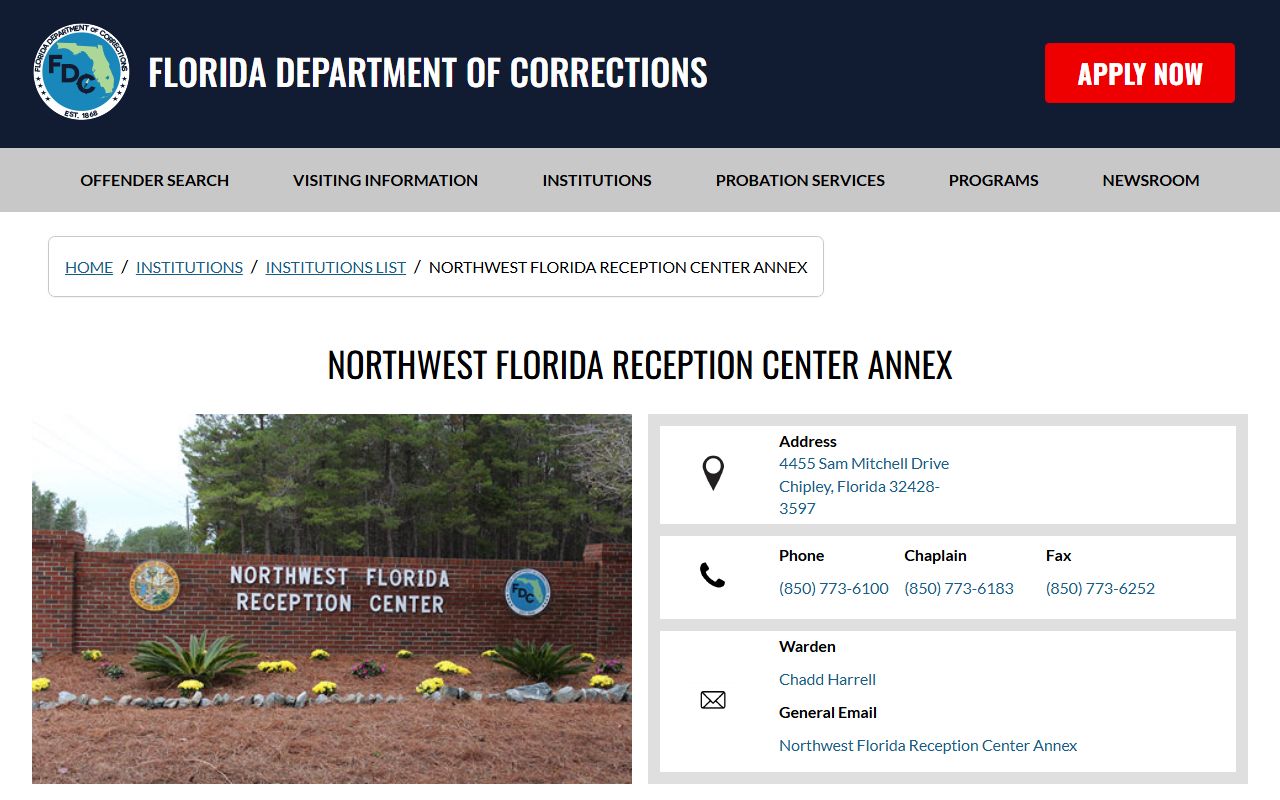
As a state prison annex, it follows DOC rules for searching, visiting, and inmate contact, which differ from the county jail's procedures in every respect.
An annex is not a lesser facility. In the Florida system, an annex is a full housing complex tied administratively to a parent institution, sharing leadership and some support services while operating as its own prison for population and capacity. That is why the FDOC gives the Annex a separate facility page and a separate capacity figure even though the sign at the gate points to one campus.
How to Look Up an Inmate at the Annex
The correct tool is the Florida DOC offender search, which covers everyone sentenced to state prison or state supervision. The county roster will not list an Annex inmate. The lead-in image below shows the DOC offender menu, the starting point for every state search. Reviewing the FDOC offender search menu shows the inmate, release, escape, and supervised-population search options.
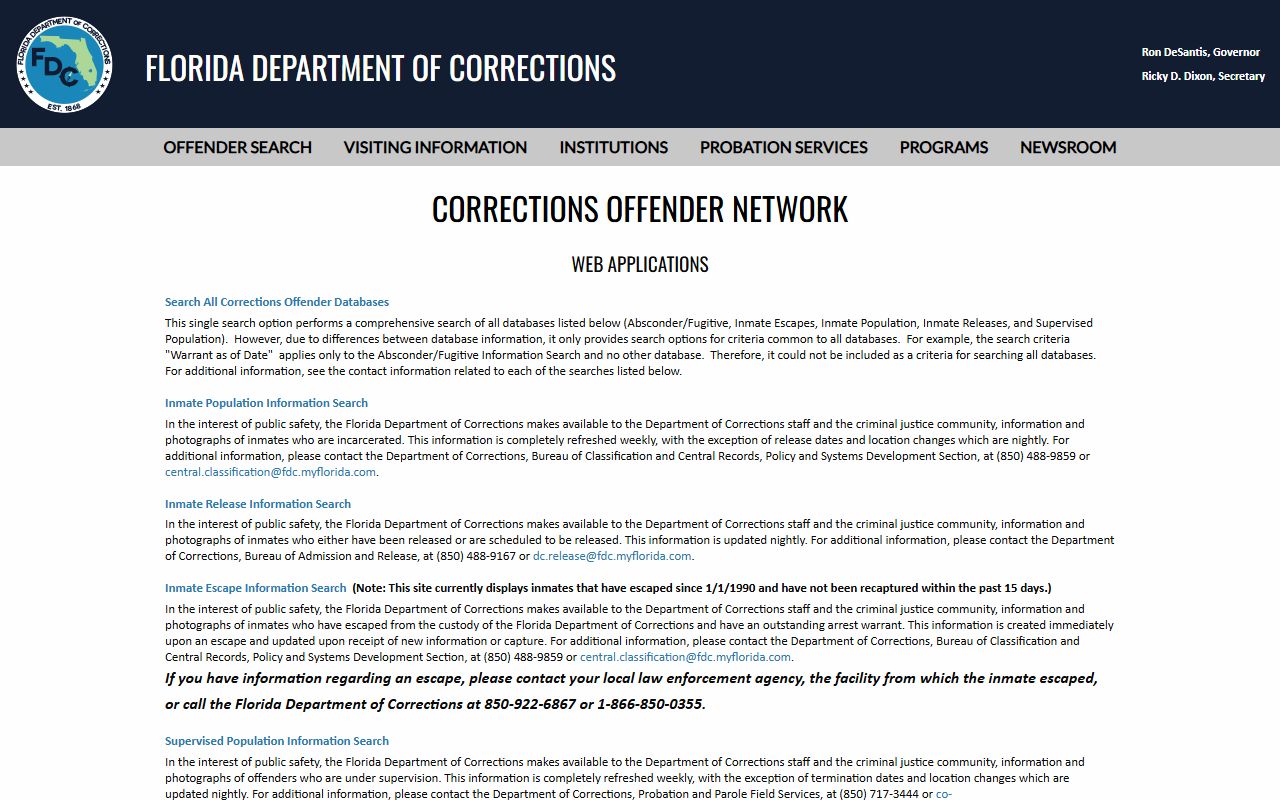
From that menu, the inmate population search is the one to use. The steps below cover a single lookup.
- Open the FDOC offender search menu and choose the inmate population search.
- Enter the inmate's last name, or a six-character DC number if known.
- Open the result and confirm the facility reads as the Annex.
- Read the location, status, offense, and sentence detail on the profile.
Note: the DOC search covers only sentenced state inmates and supervision, not county jail or county probation, and it refreshes the full population weekly.
Northwest Florida Reception Center Annex Capacity
The FDOC lists a capacity of 1,415 for the Annex, slightly larger than the 1,303 listed for the parent reception center. The population is adult male. The department does not publish a live per-facility head count, so the stat block below shows the sourced capacity rather than a current population number.
Together the two facilities account for well over two thousand state prison beds in a county whose local jail population hovers near a hundred. That contrast is the clearest sign of how separate the state and county systems are, even when they share a small Panhandle county.
Why the Annex Is Not on the County Roster
The single most common mistake is searching the county jail roster for an Annex inmate. It will never work, because the two systems hold different people and run on different databases. The table below makes the split clear.
| Annex (State Prison) | County Jail | |
|---|---|---|
| Who Is Held | Sentenced adult men | Pre-trial and short sentences |
| Run By | Florida Department of Corrections | Washington County Sheriff |
| Where to Look | FDOC offender search | WCSO inmate roster |
| Refresh | Weekly, with nightly location updates | Live current-custody roster |
If a search here comes up empty, check whether the person is actually a county detainee, a federal inmate, or held at a different state prison. Matching the custody type to the right locator is the fix nearly every time.
Annex Address and Contact
Direct prison questions to the DOC facility, not the county sheriff. The Annex shares its main contacts with the parent reception center.
Northwest Florida Reception Center Annex
4455 Sam Mitchell Drive
Chipley, FL 32428-3597
(850) 773-6100
Warden's office, FDOC
The chaplain's line is (850) 773-6183, and the warden's office email listed by the FDOC is NWFRC.WardenOffice@fdc.myflorida.com.
Visiting Someone at the Annex
Visiting a state prisoner takes approval and scheduling, unlike a county jail visit. Every visitor 12 or older must complete and submit the FDOC visitation application, using NA for any item that does not apply. The department says approval takes about 30 days, and it notifies the inmate of the outcome.
After approval, a visit must be booked through the FDOC scheduling window, which for weekly visits runs Monday at 5:00 AM Eastern to Wednesday at 5:00 PM Eastern. Walk-up visits without a scheduling form are not accommodated. Statewide DOC dress standards and item limits apply, and the Annex's restricted-housing visitation may carry added conditions, so confirm before you travel. Approval covers the inmate's whole DOC stay, so a visitor cleared while the inmate is at the Annex generally stays approved if the inmate later transfers, though the visit must still be scheduled at the new facility.
Mail, Phone, and Money at the Annex
Mail, calls, and deposits run through the FDOC system, the same as the parent facility. The department sets the approved methods, the limits, and the fees through its statewide contact-an-inmate and send-funds resources. County jail vendors and rules do not apply to an Annex inmate. Confirm the inmate's current facility before sending anything, since a reception-center campus reassigns men across the state as classification finishes. The FDOC also offers a victim notification and assistance service, the state-side equivalent of the VINELink alerts that ride on the county jail roster, for anyone who wants to track a state inmate's status.
Programs at the Annex
The Annex lists its own program slate, close to the parent center but with its own mix. The FDOC list includes Adult Basic Education, GED, a Voluntary Literacy Program, Special Education screening through Child Find, and Wellness Education. Vocational tracks include Applied Information Technology, Electrical, and Textile Repair, alongside Polk State College courses.
Treatment and faith programming runs deep as well, with Intensive Outpatient and Outpatient substance-abuse services, Prevention, Celebrate Recovery, a Faith and Character Based Program, Discipleship, Purpose Driven Life, and a Praise Band. Work and self-betterment options include IN2WORK through Aramark, a Gavel Club, Horticulture, Endovo, ATLO, a canine obedience program, OSHA training, and a Workforce Readiness track. The breadth reflects a full working prison rather than a holding annex in name only.
Several faith and personal-growth offerings round out the list, including Holy Day observations, the Most Excellent Way recovery track, religious studies and consultations, an Inmate Transitional Assistance program, and a 100-Hour Transition Program aimed at men nearing release. A chapel library and a law library program give inmates research and reading access, and a Compass 180 Transition Course supports the move back to the community. These programs sit under the DOC's institutional-betterment framework rather than anything the county provides.
About the Annex and How to Reach It
The Annex follows the same approach as its parent. From Interstate 10, take Exit 120 onto SR-77 South for about 19 miles, turn right onto SR-279 or Moss Hill Road for a quarter mile, then turn right onto Sam Mitchell Drive. Because the parent and the Annex share that address, confirm which facility an inmate is in before visiting, since the two are administered separately.
A Washington County defendant reaches the Annex only after a state sentence and DOC classification, and the assignment could just as easily be any other Florida prison. Local custody starts at the Washington County Jail, and the move to a state facility like this one comes later in the process. Because the parent reception center and the Annex sit on one campus with shared leadership, families sometimes assume an inmate is in one when records place them in the other, so the facility name on the DOC profile is the detail to trust before any visit or mailing.
Note: Confirm the inmate's current facility and an approved visit through the FDOC system before traveling, since campus assignments and visiting status can change.